Short answer: Blockchain development in Switzerland means building smart contracts, tokenized records and integrations that fit Swiss expectations on law, data protection and documentation. Through XDRIP.ch, XDRIP Digital Management LLC, a Colorado company with operations in Switzerland, offers this work in English, Italian, German and French. We do not issue regulated offerings and we do not give legal advice.
What blockchain development covers
In practice, most client projects fall into three areas:
- Smart contracts. Custom contract development, integration with existing systems, maintenance, upgrade mechanisms and gas optimization. The details are on our smart contracts service page.
- Tokenized records. Digital records for access, provenance and eligibility, with the metadata, permissions and wallet verification that make them usable.
- Integration. Connecting on-chain logic to the systems a business already runs, such as websites, customer databases or internal tools.
The chain itself is rarely the hard part. The work is in deciding what belongs on-chain, what stays in conventional systems and how both stay consistent.
Why the Swiss context matters
Switzerland has a specific legal framework for this technology. We describe it here as context, not as advice.
- DLT Act. The Federal Act on the Adaptation of Federal Law to Developments in Distributed Electronic Register Technology amended ten federal laws. Its provisions on ledger-based securities entered into force on 1 February 2021, and the remaining provisions, including the DLT trading facility licence, on 1 August 2021.
- FINMA token classification. In its ICO guidelines of 16 February 2018, FINMA classifies tokens by economic function into payment, utility and asset tokens. Asset tokens are treated as securities. Utility tokens are not, provided their sole purpose is to grant digital access to an application or service and they can be used for that purpose when issued. Hybrid forms exist.
- Data protection. The revised Federal Act on Data Protection (FADP) has applied since 1 September 2023. It requires data protection to be considered from the planning stage and processing to be limited to what is necessary.
For blockchain projects, the last point has a direct design consequence. Entries on a blockchain are hard or impossible to change or delete, so a common design keeps personal data off-chain and records only references or hashes on-chain.
How a project is structured
- Scope. What the record or contract must do, who uses it and which existing systems it touches.
- Data design. Which data goes on-chain, which stays off-chain, and who holds which permissions.
- Development. Contract logic, interfaces and the integration layer.
- Testing. Testing on a test network comes before any production deployment.
- Deployment and maintenance. Release, documentation, monitoring and planned upgrade paths.
If token classification is in question, the project owner should have it reviewed by a qualified legal adviser before development starts.
What we have built for our own products
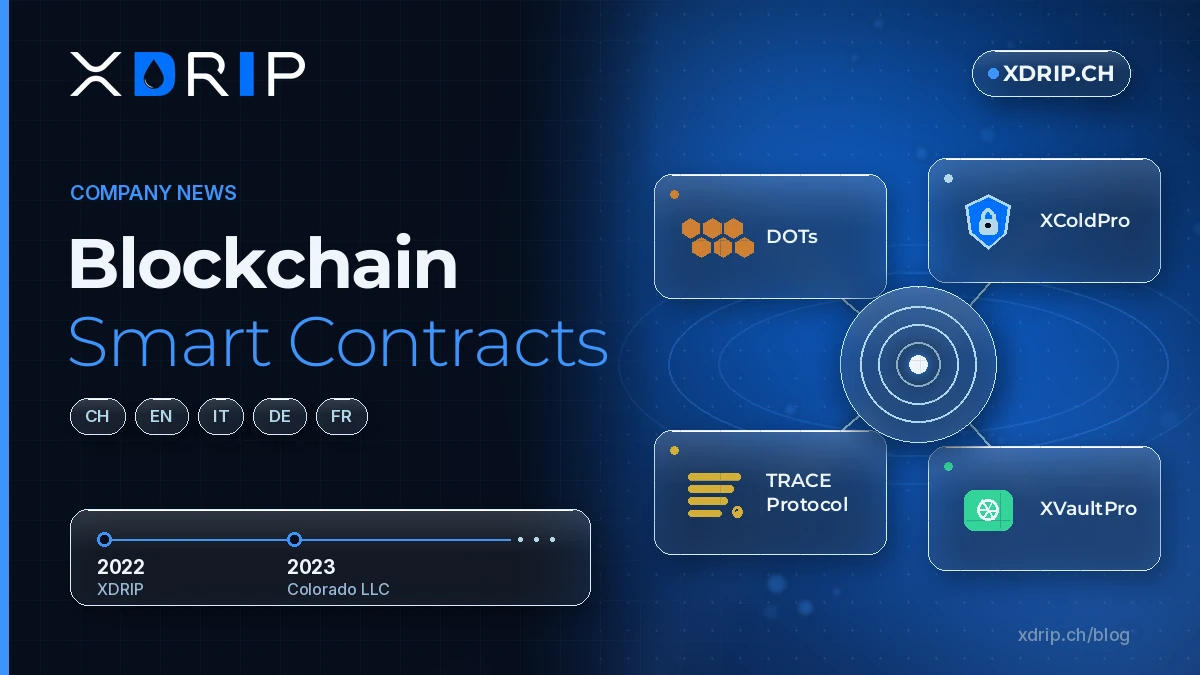
We apply the same work to our own products. DOTs, our collectible and utility records for access and provenance, are live. They are not investments or regulated offerings. XColdPro is live: air-gapped, hardware-agnostic cold storage wallet software for Windows and macOS, documented at xcoldpro.com. TRACE Protocol is in development, and XVaultPro is in active development. XDRIP has been active since 2022 and became a Colorado LLC in 2023. For a broader overview, read What Is XDRIP Digital Management? or the XDRIP Knowledge overview. For news across our Universe, XDRIP Central is our information hub.
What we do not do
- We do not issue or arrange regulated financial offerings or investment products.
- We do not tokenize real estate ourselves.
- XMarket is planned and in development, not live.
- We do not provide legal, tax or regulatory advice.
FAQ
Is XDRIP a Swiss company?
No. XDRIP Digital Management LLC is registered in Colorado, United States, and has operations in Switzerland. XDRIP.ch is our site for that work, available in four languages.
Which blockchain services can we discuss through XDRIP.ch?
Smart contract development and maintenance, tokenized records for access, provenance and eligibility, and the integration of blockchain components with existing systems.
Is every token a security in Switzerland?
No. FINMA assesses tokens by their economic function. Asset tokens are treated as securities, while utility tokens that only grant digital access and are usable at issue are not. Each project needs its own legal assessment.
Should personal data be stored on a blockchain?
Generally not. Because blockchain entries are hard to change or delete, a common approach keeps personal data off-chain and stores only references or hashes on-chain, in line with the FADP principles of data protection by design and data minimisation.
How do we start a project?
Write to us through the contact page on XDRIP.ch with a short description of the scope. We then discuss the scope and the practical next steps.
Sources
- Federal Council, DLT Act fully in force from 1 August 2021: news.admin.ch
- FINMA, ICO guidelines, 16 February 2018: finma.ch
- Federal Act on Data Protection (FADP), SR 235.1: fedlex.admin.ch
This article is general information and not legal advice.