Short answer: Real-world asset tokenization is the process of recording a claim on a physical or financial asset, such as a property, a bond or a commodity, as a token on a programmable ledger. The token is only as strong as the legal link between the record and the asset: the technology automates transfers and checks, but the rights themselves come from contracts and law. Through XDRIP.ch, XDRIP Digital Management LLC builds tokenized records for access, provenance and eligibility; we do not issue asset tokens or investment products.
What does real-world asset tokenization mean?
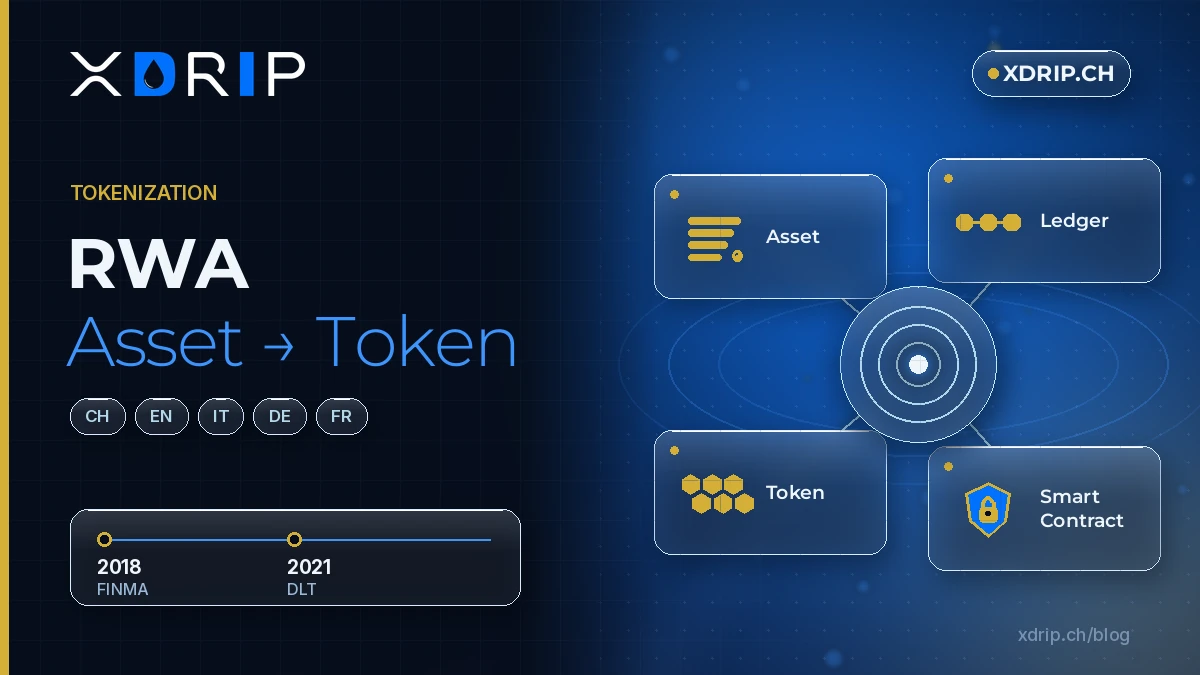
The Bank for International Settlements (BIS) describes tokenisation as "the process of recording claims on real or financial assets that exist on a traditional ledger onto a programmable platform" (BIS Bulletin No 72, 11 April 2023). Three elements are involved:
- The asset. A building, a machine, a batch of goods, a loan or a share. Some assets already have an official register, such as a land register for property; others do not.
- The ledger. The record of who holds which claim. Traditionally it is a database run by a trusted operator. In tokenization it becomes a programmable ledger, usually a blockchain.
- The token. According to the BIS, a token combines a core layer that identifies the asset and its holder with a service layer that contains the rules for its use, typically written as smart contracts.
"Real-world" simply separates these assets from those that exist only on-chain, such as cryptocurrencies.
How does tokenization work in practice?
A tokenization project is mostly legal and organisational work, with a technical layer on top. The usual sequence:
- Define the right. What exactly does the token represent: ownership, a share of income, a usage right, or only a record of provenance? This decision drives everything else.
- Create the legal link. A contract or registration agreement has to state that the right exists in, and is transferred through, the token. Without it, a token is a database entry with no enforceable claim behind it.
- Lock the asset off-chain. The BIS calls this step the "ramp": the original asset must stop circulating in its old system while the token circulates on the new one. For property, title still sits in local registries, which the BIS names as a reason full automation is difficult.
- Build the ledger logic. Smart contracts define who may hold or transfer the token, which checks apply (for example wallet verification or eligibility rules) and how errors are corrected.
- Operate the lifecycle. Metadata, permissions, transfers, corrections and, at the end, redemption or cancellation of the token.
Where are the limits of tokenization?
The BIS bulletin is explicit that technology does not remove the reasons intermediaries exist. Information gaps between parties, legal ownership questions and cross-border rules remain. Its "tokenisation continuum" summarises the trade-off: assets that are easy to tokenize, because they are already digital and standardised, tend to offer modest gains, while assets with the largest potential gains, such as commercial real estate or syndicated loans, are the hardest to tokenize.
Two practical consequences follow. First, a token does not change who owns a building; the contract and the register do. Second, every project needs a clear answer to what happens when the on-chain record and the off-chain reality disagree.
How does Swiss law treat tokens that represent assets?
Switzerland has two reference points. We describe them as context, not as legal advice.
- Ledger-based securities. Since 1 February 2021, Art. 973d of the Swiss Code of Obligations allows a right to be registered in a securities ledger and to be exercised and transferred only through that ledger. The ledger must meet four requirements: creditors, not the obligor, hold the power of disposal; its integrity is protected against unauthorised changes; the content of the rights, the functioning of the ledger and the registration agreement are recorded; and creditors can check the entries relating to them without a third party.
- FINMA token classification. In its ICO guidelines of 16 February 2018, FINMA distinguishes payment, utility and asset tokens. Asset tokens represent assets such as participations in real physical underlyings, companies or earnings streams, or an entitlement to dividends or interest; in economic terms they are analogous to equities, bonds or derivatives, and FINMA treats them as securities. Each case is assessed on its own merits.
A wider overview of the Swiss framework is in our article on blockchain development in Switzerland.
What we do and what we do not do
Our tokenization services create verifiable digital records for access, provenance, eligibility and product utility. The work covers metadata, permissions, wallet verification, smart contract deployment and integration with the systems a business already runs. Our Digital Access Records document access rules, provenance, recognition tiers and eligibility. They give no ownership interest, no right to profits or distributions, and no governance or voting rights.
We do not issue asset tokens, we do not tokenize real estate ourselves and we do not offer investment products. If a client project would create securities or another regulated product, it needs its own legal and regulatory assessment by qualified counsel before any technical work starts. How these records fit into the wider XDRIP Universe is described in the XDRIP overview on XDRIP Knowledge.
FAQ
Is owning a token the same as owning the asset? Not automatically. A token carries only the rights that the underlying contract or legal framework attaches to it. Without that legal link, it is a record, not a title.
Are tokenized assets securities in Switzerland? It depends on the function of the token. FINMA treats asset tokens, which are economically comparable to equities, bonds or derivatives, as securities, and decides each case individually.
Does XDRIP tokenize real estate or sell investment tokens? No. We build tokenized records for access, provenance and eligibility. We do not tokenize real estate ourselves and our records carry no ownership, profit or voting rights.
Which assets are easiest to tokenize? According to the BIS, assets that are already digital and standardised are the easiest, but they also tend to offer the smallest gains. Physical assets with local registers are harder because the off-chain record must stay in sync.
Does every record need a blockchain? No. A shared ledger helps when several parties must verify the same records without trusting a single operator. Where one party controls all the data, a conventional database is often the better choice.
Sources: BIS Bulletin No 72 "The tokenisation continuum" (11 April 2023); Swiss Code of Obligations, Art. 973d (in force since 1 February 2021); FINMA ICO guidelines (16 February 2018).